
Spain is easy to travel in, once you know how it works: the transport passes, the meal times, the taxi rules and the shop hours. This guide covers the practical side of a first trip — the things our city guides assume you already know.
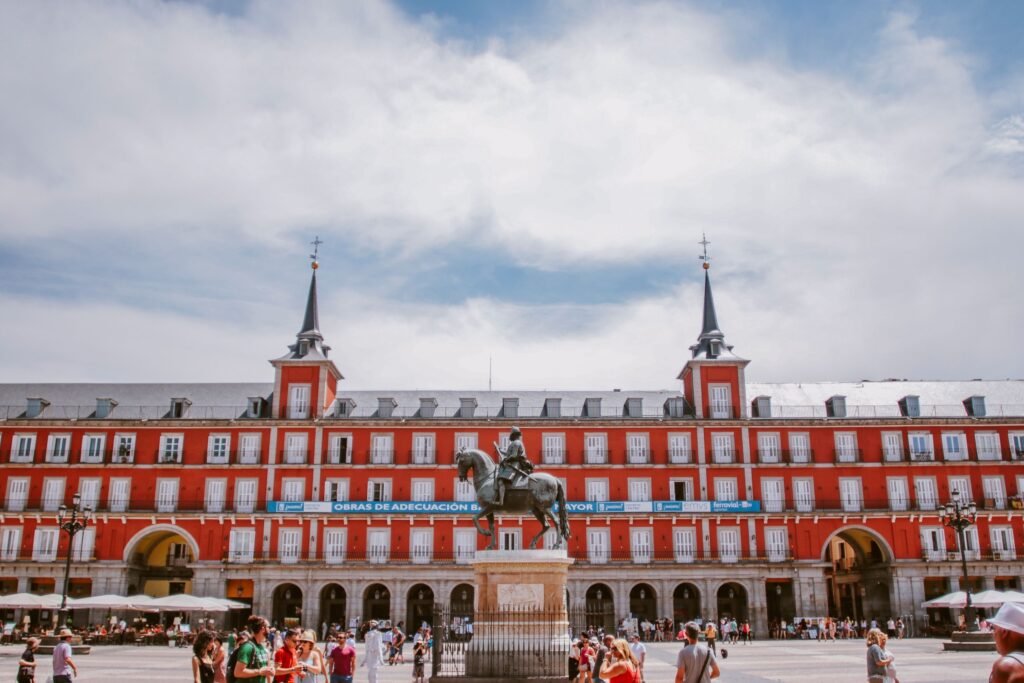
Photo: Plaza Mayor, Madrid — Luis Quintero / Pexels
The short version
Stay in the centre, near a metro stop. In Barcelona or Madrid, buy the tourist travel pass if you will ride a lot; in Valencia and Seville the day tickets are cheap. Between cities, take the high-speed train and book it weeks ahead. Eat lunch between 1 and 4, dinner from 8. Carry some cash for small bars and markets, and a few words of Spanish.
Getting around
The centres of Spain’s big cities are walkable, and the metro, bus and tram fill the gaps. You rarely need a car in a city.
Barcelona has a metro, TMB city buses and a tram. From the airport, the Aerobus shuttle costs €7.45 and takes about 35 minutes to the centre; the metro line L9 Sud needs a €5.50 airport ticket; the R2 Nord train runs from Terminal 2.
Madrid has a metro and EMT city buses. Since June 2026 you can tap a contactless bank card at the metro gates to pay for a single journey. From the airport, Metro line 8 reaches Nuevos Ministerios in 15 to 20 minutes for about €4.50 to €5, including the €3 airport supplement; the Exprés Aeropuerto bus (line 203) costs €5, runs 24 hours and goes to Atocha via Cibeles; the Cercanías train leaves only from Terminal 4.
Seville is best on foot in the old centre, with the Metrocentro tram running from Plaza Nueva past the Cathedral to San Bernardo. A single bus or tram ticket is €1.40, bought on board. The airport has no train; the EA airport bus costs €6.
Valencia has a metro and tram network plus EMT buses. From the airport, metro lines 3 and 5 reach the centre in about 20 to 25 minutes; a single ticket is €4.80.
Palma runs on EMT city buses at a flat €2 a ride. From the airport, the A1 bus reaches Plaça d’Espanya in about 20 minutes for €3 if you tap a contactless card, or €5 in cash.
Between cities, the high-speed train is the answer. Renfe’s AVE and its low-cost Avlo share the lines with Ouigo and Iryo, so four companies compete on the main routes. Madrid to Barcelona takes about 2 hours 30 minutes. Book four to eight weeks ahead for the cheapest fares — advance tickets start from around €10, and the same seat bought on the day can cost several times more. Regional and Cercanías trains can usually be bought on the day, and no reservation is needed.
Tourist passes
If you are staying several days in one city and riding a lot, a pass pays for itself. If you are mostly walking, singles are cheaper. All prices below are 2026 fares — check before you go.
Barcelona — Hola Barcelona. Unlimited metro, TMB buses, night buses, tram, FGC trains in zone 1, Rodalies trains in zone 1 and the Montjuïc funicular, for 24, 48, 72, 96 or 120 consecutive hours from first use. One metro trip from the airport and one back is included. It does not cover the Aerobus, the Montjuïc cable car or the Bus Turístic. Prices: €12.50 for 24 hours, €18.70 for 48, €27.30 for 72, €35.60 for 96 and €43.60 for 120 hours. Buying online is 10% cheaper. Children under 4 travel free.
Madrid — Abono Turístico (Tourist Travel Pass). Unlimited metro, EMT buses (except the Exprés Aeropuerto bus) and Cercanías within the zone you buy, for 1, 2, 3, 4, 5 or 7 days. Zone A covers central Madrid and the airport, with no airport supplement to pay. Zone T covers the whole region, including Cercanías day trips to Aranjuez, Alcalá de Henares and El Escorial. Prices, Zone A: €10.30, €17.50, €23.10, €27.80, €33.40 and €43.20. Prices, Zone T: €15.40, €26.20, €35.00, €43.20, €50.40 and €62.80. The pass is not valid on AVE or Avant high-speed trains, so it does not cover Toledo or Segovia. If you will ride only a few times a day, the cheaper option is a Tarjeta Multi card (€2.50) loaded with a 10-trip Metrobús (€7.30, at the 2026 discounted price).
Valencia — SUMA T1. Unlimited metro, tram, EMT buses, Metrobus and Cercanías in zones A and B for 24 hours at €4.50; 48 hours (T2) is €7.50 and 72 hours (T3) is €11.00. With the airport stop included, the prices are €9.00, €14.00 and €17.00. A single bus ticket is €2.00 and a metro single €1.50, so the day ticket pays from the third bus ride.
Seville — Tarjeta Turística. One day for €5 or three days for €10, valid on Tussam buses and the Metrocentro tram. It does not cover the EA airport bus.
Malaga and Palma have no tourist pass worth chasing. Pay per ride — Palma’s EMT buses are a flat €2, and the A1 airport bus is €3 by card.
If you plan several museums in Barcelona, the Barcelona Card adds free entry to more than 25 museums to the same transport, from €39 for 48 hours. In Valencia, the Valencia Tourist Card (€17 for 24 hours, €24 for 48, €30 for 72) adds monuments and the airport metro.
Taxis
Taxis in Spain are licensed and metered, and the fares are set by the city — the meter must be running, and the price is not something to haggle over. You can hail one on the street (a green light means it is free), find them at ranks outside stations, airports and hotels, or book by app.
In Madrid the taxis are white, and the airport run is a flat €33 to anywhere inside the M-30 ring road, day or night, luggage included. In Barcelona they are black and yellow.
The apps that work in the big cities are Free Now, which books licensed taxis and runs on the meter, and Cabify, which books private-hire cars and shows the price before you confirm. Uber and Bolt also run in Madrid, Barcelona, Valencia and Seville. A taxi booked through an app charges the card on file, and foreign cards are accepted.
Tipping a taxi driver is not expected. Rounding the fare up is plenty.
Where to stay
Stay in the centre, near a metro stop. That matters more than the hotel itself: a cheap room far from the metro costs you the saving back in taxi fares and time.
In Barcelona, the Gothic Quarter and Gràcia are both in our guide and both work well as bases. In Madrid, stay around Puerta del Sol and Gran Vía, or near Retiro. In Seville, the Santa Cruz old town or Triana put you in the middle of it. If a hotel is outside the centre, check the nearest metro stop before you book.
Book early for Easter week, August and long weekends, when rooms and trains both fill up.
Money
Spain uses the euro. Cards and phone payments are accepted almost everywhere, but carry some cash for small bars, markets and tips. ATMs are easy to find on main streets in city centres.
Tipping is optional. Service is included in the bill, so a tip is a small extra for good service — loose change in a bar, or rounding up the bill in a restaurant. Leaving 5 to 10% for a very good meal is generous; nobody expects more.
Meal times
Lunch is the main meal of the day, usually served between 1 and 4 in the afternoon. Dinner is served between 8 and 11:30 at night, and restaurants usually start serving it from about 8. If you turn up at 6:30 expecting dinner, you will find kitchens closed — eat lunch late, or have tapas to bridge the gap.
Tapas are small plates shared with a drink. Order a few between you and share them; that is how they are meant to be eaten. Breakfast is usually light — coffee and toast or a pastry.
Good to know
A few words of Spanish go a long way. These cover most situations:
- Hola — hello
- Gracias — thank you
- Por favor — please
- La cuenta, por favor — the bill, please
- ¿Habla inglés? — do you speak English?
- ¿Cuánto cuesta? — how much is it?
Shops usually open from about 10 in the morning to 9 at night. Small shops often close between 2 and 5 in the afternoon, and Sunday is the usual closing day — plan shopping for Saturday.
A few practical facts: the emergency number is 112. Traffic keeps to the right. The international dialling code is +34, and plugs are the two-pin European type C and F, on 230 volts. Mainland Spain and the Balearic Islands run on Central European Time, one hour ahead of London and two hours ahead in summer; the Canary Islands are one hour behind the mainland.
Updated 28 November 2026.